
A Temple for Purposeful Dreaming with Richard Branson.
It’s hard to know where to begin when writing about the famed Sir Richard Branson. Countless articles have been written about him and he is his own best spokesperson, having written numerous best-selling books and more recently, sharing his thoughts on business and corporate responsibility via social media.
But when you have the immense privilege to spend time in his presence on Necker Island, the call to share the experience with others is strong. There is ample reason he is the icon he has become and I can’t think of a better example of a business leader who exemplifies the principles of Evolutionary Business, putting purpose before profit.
Spending a week on Necker Island isn’t free, but getting invited once, let alone twice, feels like winning the lottery. But beyond the adventure sports, pranks, natural beauty of the island and opportunity to meet smart, talented, forward-thinking people, the opportunity to soak up Richard’s devotion to doing good in the world deepened and reaffirmed my belief that businesses putting purpose above profit is the way of the future.
Necker Island: A Place to Be and Dream
When we work with clients, we urge them to hold off-sites in locations that allow for reflection and reconnection to their original vision that compelled them to start their company. The right setting can help leaders reconnect to the vision, allowing teams to address their fears head on and ultimately refocus how to move forward as more conscious leaders. While few start-ups have the budget or time to fly to a remote island, Necker is a great example of a magical space that inspires creativity, collaboration, and reflection.
I’ve been fortunate to visit many of the world’s greatest beaches and islands, and can say unequivocally there is nothing like Necker. Situated amidst several other smaller islands, it’s like a fairytale with dazzling white sand beaches, lush vegetation, and some nearly 300 different species of wildlife that Branson brought in to preserve and repopulate the Caribbean with animals that were near extinction.
Everyone knows Richard has always been a big dreamer. He wasn’t deterred by the $6 million asking price of Necker when just starting out with Virgin Records and he ultimately bought the island for $180,000. Today, the island serves as his home and gathering place for his family, but it is a business unto itself. Everyone who spends time with Richard on Necker, unless you are a close friend or family, pays for his time (to his charity, Virgin Unite). He welcomes entrepreneurs and business leaders who are looking to make a positive change in the world and he participates in many of the functions himself, but you feel his presence everywhere on the island regardless of his physical proximity.
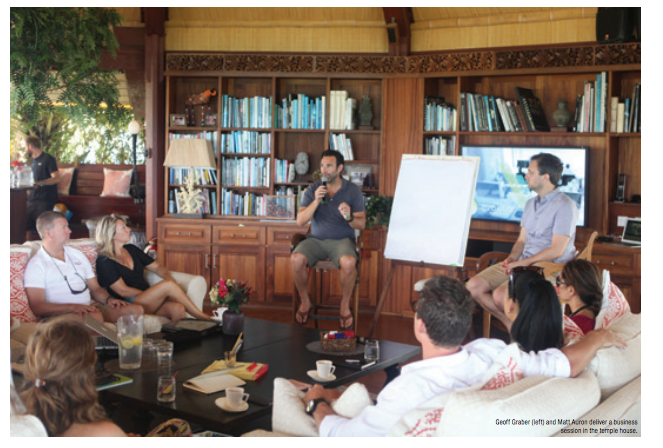
The Temple is an open air living room space next to his personal house that is ideal for sharing ideas and brainstorming. This is where my partner, Matt Auron and I led workshops, guiding participants through a meditative process to visualize something in their leadership or business that they were unhappy with to shift to a new mental model that could lead to a different, more desirable direction.
But you don’t need a temple on a remote island to shift your mindset. Below are a few tips one can learn from Sir Richard himself.
Trust Your Team
One of the things we see over and over again in the entrepreneurs and founders we work with is how difficult it can be to trust in the judgment and abilities of those they’ve hired to help run their businesses. Most see themselves as both founders and CEOs.
For years, Branson has recognized that his best gift is to get things started and then hand them off to others to run. He sees himself as founder and then chairman. It sometimes frustrates him that he doesn’t make all the decisions, but he recognizes his strengths and the freedom that gives him to be out of day-to-day operations. He also believes that he is an excellent judge of character and has hired extremely well—people who are much better at running those businesses he started than he would have been. While this certainly doesn’t apply to every founder and CEO, there’s an important lesson to be learned about trusting your team and knowing when to step back.
Don’t Underestimate the Value of Humility
Branson is not the loudest in the room. In fact, he is far from it. He’s very humble and somewhat introverted. He doesn’t draw attention to himself on the island, and doesn’t look people in the eyes until there is something he’s prepared to discuss. But his curiosity is insatiable, so that happens frequently and then he happily engages. He enters and exits parties and gatherings with little fanfare. He’s the best I’ve met when it comes to disappearing from dinners and events. No good-byes. No, “well, it is time for me to go.” No excuses. He just goes when it’s time.
Great leaders understand they don’t always have all the answers and know when to let others take the lead. It was fantastic to see Branson’s charisma and confidence shine through in this quiet and thoughtful way. Not what you’d always expect from the guy who featured in ads with bikini-clad models or appearing in drag to serve Virgin passengers.
Legacies Matter, So Be Purposeful
Few business leaders are remembered for how much money they made or how many companies they founded (for the record, Branson has started close to 500). Instead, they are remembered for disrupting industries, changing consumers’ relationships and expectations of products and services, and being a positive force for good in the world.
Branson has devoted his life to building successful businesses and at this point, he could easily retire and reap the rewards of a life filled with hard work. But he feels deeply a calling to do good and for years, he has imbued his businesses and ventures with a strong commitment to social and corporate responsibility.
Whether it’s taking on clean water, global poverty, or climate change, Branson and his businesses are working to change the role of big corporations in taking some ownership in addressing these complex problems. He has an insatiable appetite to make the world a better place and is tireless in helping to establish Evolutionary Businesses. He also has started a number of non-profits. I asked him why he wouldn’t just create new businesses to address these complex social problems since he believes in – and is experienced in – the for-profit structure as being a force for good. He told me that there are some circumstances where a business just wouldn’t be a good fit, because it couldn’t operate sustainably on its own, and for those, he creates not-for-profits that still operate like an efficient business and serve all of their stakeholders: another type of Evolutionary Business.
Have Fun
The final important affirmation from my time with Branson was that fun is fundamental for effective leaders to thrive. Having fun, and the leisure time built into schedules to allow for it, allows us to think freely, explore our curiosities, connect with others, and engage with the other parts of our lives more fully.
Most mere mortals can’t live life like Sir Richard, but any leader or entrepreneur can find their temple, dream big, and have some fun along the way.



 LinkedIn
 Evolution Twitter
 Evolution Facebook